Alternator charging: stock alternator or a second alternator
Charge from the van's stock alternator through a DC-DC charger, or add a dedicated secondary alternator at 12, 24 or 48 volts to match your house bank.
 Illustration
Two ways to charge from the engine
Charge off the stock alternator
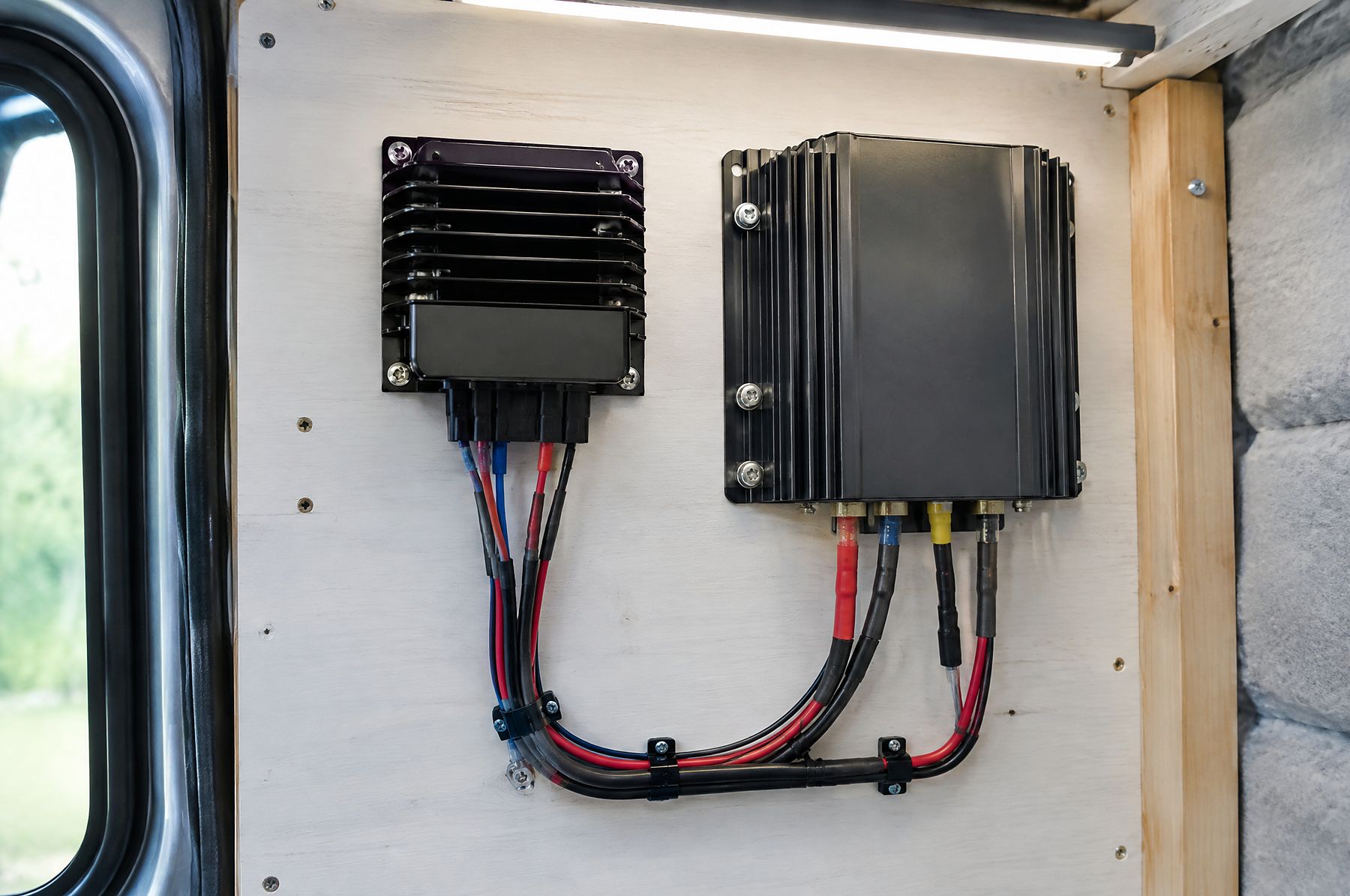
A DC-DC charger sits between the van's starting system and your house bank and takes a controlled amount of current from the factory alternator. We install the Victron Orion XS 12/12-50A: up to 50A, fanless, and compatible with the smart alternators on modern Sprinters and Transits. Two can run in parallel for about 100A. This is the simplest option for a 12V house bank, and DC-DC converters also exist for charging a 24V bank from the 12V van side.
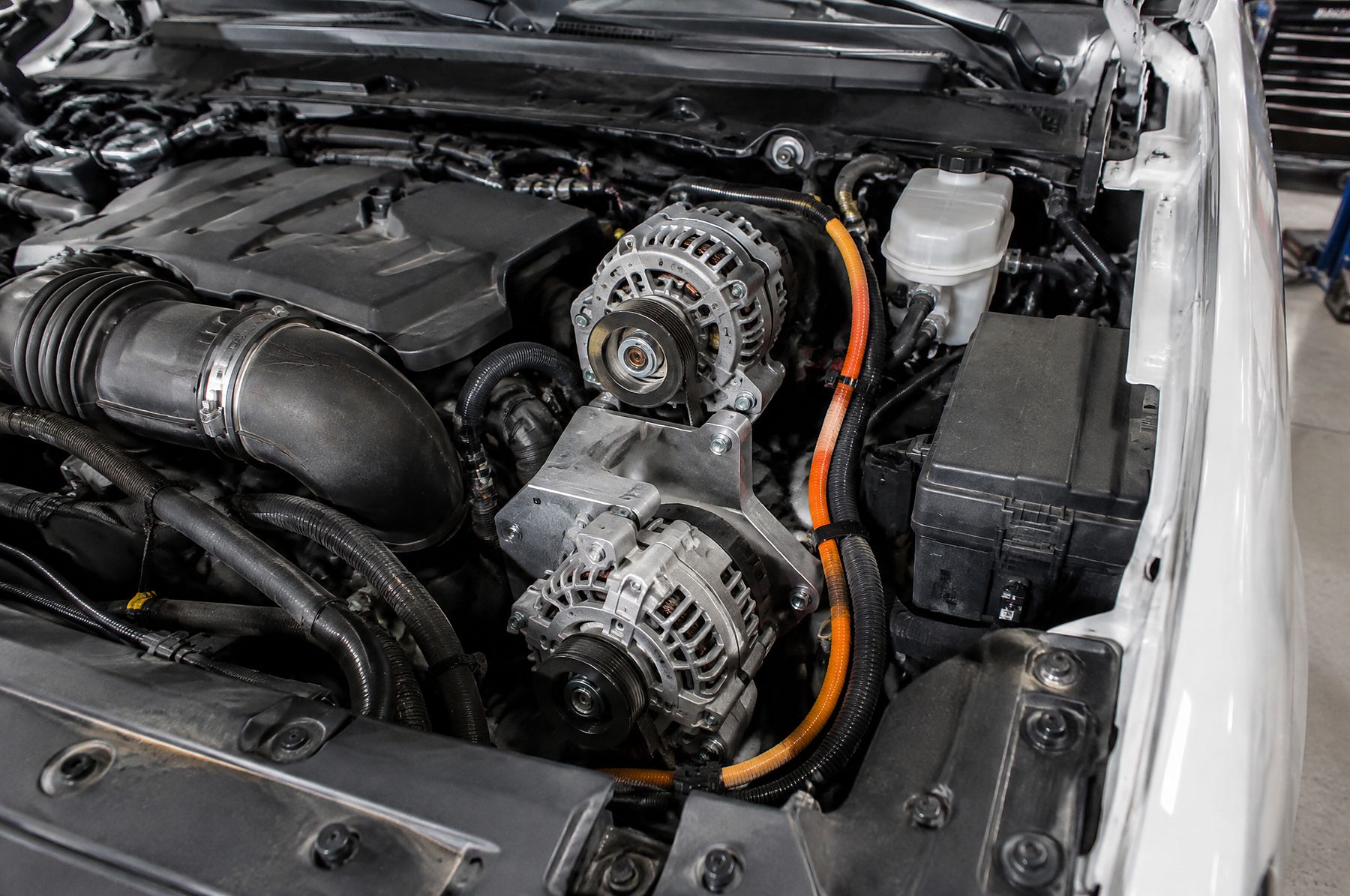
Add a secondary alternator
A second, dedicated alternator mounts on the engine with its own bracket and belt and charges only the house bank. It's built to match your house bank voltage, 12, 24 or 48 volts, and controlled by a Wakespeed WS500 external regulator with alternator and battery temperature sensors and Balmar APM load-dump protection. Higher voltage means far more charging power on thinner cable, which is what makes AC and induction cooking practical. We source these kits through Vanlife Outfitters and 12 Volt Power, and the WS500 can talk CAN to your battery and a Victron Cerbo GX.
One alternator, no engine changes. The alternator keeps charging the starter battery as it did from the factory, and a DC-DC charger takes a controlled share for the house bank, fused at both ends.
- 1Stock alternator no changes to the engine
- 2Starter battery in parallel with the alternator, as from the factory
- 3Fuse at the source sized to the cable
- 4DC-DC charger Victron Orion XS, limits current and sets the lithium profile
- 5Fuse at the battery
- 6Lithium house bank
The second alternator charges only the house bank, through load dump protection and a fuse. The regulator sits off the power path and controls the alternator through its field wire, using voltage, temperature and battery data. The stock alternator and starter battery are left alone.
- 1Second alternator belt-driven, engine-specific bracket
- 2Load dump protection Balmar APM, clamps the spike if the BMS disconnects under charge
- 3Fuse at the battery sized to the cable
- 4Lithium house bank charge profile and temp limits
- 5External regulator Wakespeed WS500, drives the field through thin control wires, not in the power path
- 6Starter battery stays on the stock alternator, not connected to alternator 2
Stock alternator vs secondary alternator
| Setup | House bank | Charging power | Best for |
|---|---|---|---|
| Stock alternator + Orion XS | 12V | Up to 50A per unit (about 700W), two for about 100A | Weekend and part-time vans, solar-heavy systems, Revels |
| Stock alternator + DC-DC to 24V | 24V | Limited by the converter | Smaller 24V systems without engine work |
| Secondary alternator, 12V | 12V | Kits rated up to about 280A | Large 12V banks, full-timers |
| Secondary alternator, 24V | 24V | Kits around 150A (about 3.6kW) | Big inverters, AC on a 24V system |
| Secondary alternator, 48V | 48V | Kits around 100A (about 5kW) | AC and induction on 48V systems |
Alternator kit ratings are manufacturer figures; real output depends on RPM and heat. Kits are engine-specific: the Sprinter 3.0L V6, the 2023+ Sprinter 2.0L and the Transit all use different hardware.
How we do it
Check the chassis
Engine and year decide the kit: the Sprinter 3.0L V6, the 2023 and newer 2.0L four-cylinder, and the Transit all use different hardware.
Size the system
We match charge rate to your bank size, voltage and battery limits.
Mount and route
Alternator bracket and belt, or Orion XS mounted near the bank, with cable sized for the current and fused at both ends.
Sensors and comms
Alternator and battery temperature sensors, shunt, and CAN to the BMS and Cerbo where supported. Balmar APM fitted on alternator systems.
Program and road test
Lithium charge profile, current limits and temperature derates set, then tested driving and idling while we watch alternator temperature.
What to know before you buy
Your engine matters
Second-alternator kits for the 3.0L V6 Sprinter don't fit the 2023+ 2.0L. Tell us your exact year and engine.
Battery communication
Some 48V and high-output kits only approve batteries that talk CAN to the regulator. We check yours before ordering.
Cold mornings
Lithium can't be charged below freezing. Heated batteries or temperature cutoffs keep a cold-morning drive from damaging the bank.
Don't overload factory aux points
Upfitter takeoffs on modern vans have limited current. A DC-DC or second alternator is the right way to pull real charging power.
Questions about alternator charging
Should I use my stock alternator or add a second one?
If you have a 12V bank, mostly take shorter trips and have solar, a DC-DC off the stock alternator is usually enough. If you run AC, cook on induction or have a big 24V or 48V bank, a secondary alternator is worth it.
Will lithium hurt my stock alternator?
Not with a DC-DC charger in between. Wiring lithium straight to the alternator can overheat it, which is exactly what the Orion XS prevents.
Why 24 or 48 volts?
The same power at higher voltage means far less current, so thinner cable, less heat and a lot more charging power from a secondary alternator.
Can you do this on a Revel?
Yes. We've replaced a Revel's second alternator with an internally mounted Orion XS.
Get a charging quote
Send a few details and we will call you back with ideas, options and a ballpark.
- 6771 Emigration Canyon Rd, Salt Lake City
Office visits by appointment - 5.0 on Google from 39 reviews
Read what owners say